
Fifteen East Texas Counties Back a Regional Groundwater District. The Hard Decisions Come Next
East Texas Water Plan: Who Sets Fees?
A proposed Northeast Texas Groundwater Conservation District has support from 15 counties, but it still needs a 2027 state law—and residents have important questions about its board, fees, permits and local control.
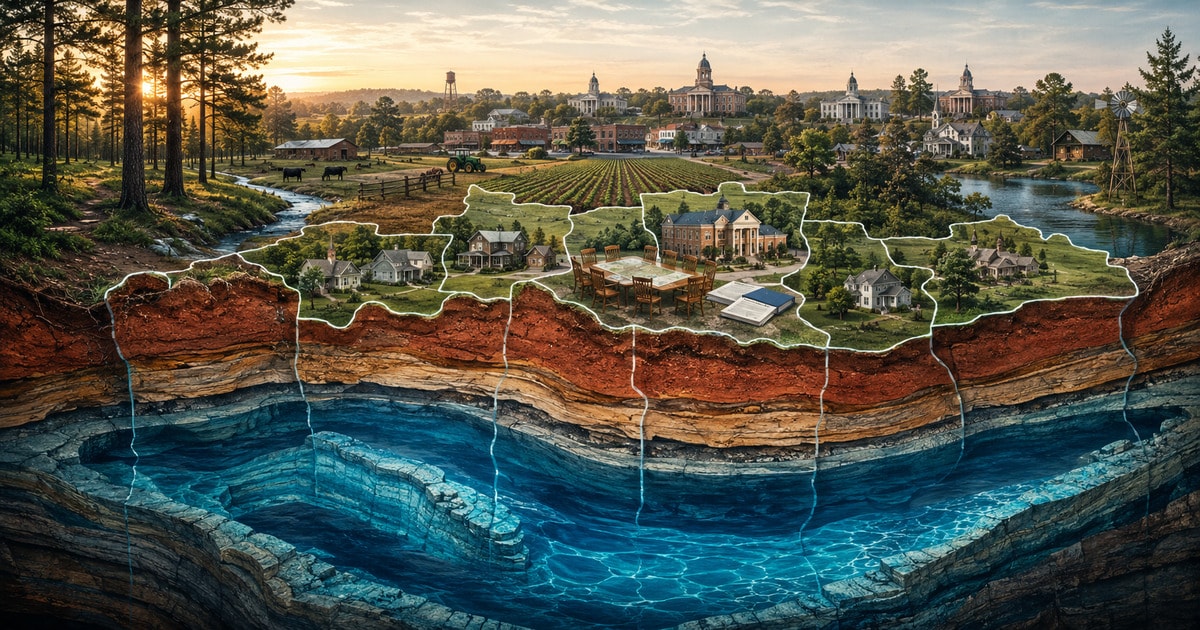
Fifteen East Texas counties have taken an important first step toward regulating groundwater across a region that has long had fewer local pumping controls than much of the state. The proposed Northeast Texas Groundwater Conservation District could give participating counties a shared system for large-well permits and aquifer protection. It is not yet a functioning district, however, and the county resolutions adopted this summer do not settle its boundaries, board structure, financing or permit rules.
That distinction is the starting point for public accountability. Gregg County commissioners approved a resolution supporting the effort on July 14, according to The Texas Tribune. Upshur County commissioners followed on July 15; the official county agenda listed discussion and possible action on an agreement related to groundwater conservation. By then, attorney Brian Sledge, who is helping organize and draft the proposal, said 15 counties had signed on. Local reporting has also identified Smith, Harrison, Wood and other Northeast Texas counties as participants in the regional push.
The counties cannot create the full district by resolution alone. Organizers intend to ask the Texas Legislature to pass an enabling bill when the regular session begins in January 2027. That legislation would establish the legal district and define the framework local officials must operate within. Until lawmakers publish and pass that bill, residents should treat descriptions of the future district as proposals—not completed policy.
Why counties are acting now. Much of Northeast Texas sits above the Carrizo-Wilcox Aquifer, a major water source for homes, farms, public systems and industry. The Texas Water Development Board's maps show that several counties above the aquifer are not covered by a groundwater conservation district. Under Texas' rule-of-capture tradition, the absence of a district can leave local governments with limited tools to regulate large groundwater withdrawals.
The pressure is visible in the state's own planning record. The adopted 2026 Region C Water Plan, approved by the Texas Water Development Board in January, includes strategies for North Texas water suppliers to develop groundwater outside Region C. The Texas Tribune reported that one plan concept would draw 25,000 acre-feet—about 8.1 billion gallons—from beneath Smith, Wood, Van Zandt and Upshur counties. The plan's language notes that without groundwater districts in the targeted counties, pumping regulations or limitations may not constrain full project development.
A regional district would not make every proposed transfer disappear. Groundwater districts operate under state law and must follow permitting, planning and due-process requirements. Their authority is significant but not unlimited. The practical change is that very large wells could face locally administered rules, production limits, fees, monitoring and permit review instead of operating in a county with no district-level groundwater regulator.
The proposed district is separate from the Neches & Trinity Valleys Groundwater Conservation District farther south. That existing district covers Anderson, Cherokee and Henderson counties and is currently involved in a separate legal and regulatory fight over proposed high-capacity wells. Combining the two stories can obscure which board, lawsuit or permit controls which project. The Northeast Texas proposal is a new multi-county district that still requires legislation; the Neches & Trinity Valleys district already exists.
What remains undecided. First is representation. A district covering roughly 15 counties must decide how many directors sit on its board, who appoints or elects them, how counties of different populations are represented and what happens if a county later wants to join or leave. A board that is too small could dilute local voices; a board that is too large could become difficult to govern. The bill should state the answer plainly.
Second is money. Local reporting says organizers prefer fees on large-volume pumping rather than a new property tax. That preference is not the same as enacted law. Residents deserve to see the proposed fee authority, the well-size or pumping threshold that triggers it, exemptions for domestic and livestock wells, the district's startup budget, and any county obligation before legislators vote.
Third is permitting. The bill and later district rules should clarify whether existing wells are grandfathered, how export projects are evaluated, what science supports production limits, how neighboring wells are protected and how applicants or affected landowners can appeal. A conservation district should not become an opaque veto point, but it also should not be a rubber stamp for withdrawals that shift long-term risk onto rural communities.
Fourth is data. The strongest rules will depend on measured water levels, pumping volumes, recharge estimates and models that can be inspected by the public. Texas has adopted its 2027 State Water Plan, which organizes regional strategies into a statewide roadmap, but a planning estimate is not a permit decision. The district should publish the evidence it uses and update decisions when monitoring changes the picture.
There is also a regional coordination problem. If most counties over a shared aquifer join but one remains outside, a large user may seek the least-regulated location even though pumping effects do not stop at a county line. That is the core case organizers make for a multi-county approach. It is also why each participating commissioners court should disclose what it has agreed to and whom it appointed to represent local residents during drafting.
State Rep. Jay Dean has been identified in local reporting as one of the East Texas lawmakers working with county leaders on the proposal. His role, and that of every regional legislator who may carry or amend the bill, should be judged on the published text. RepWatchr will look for clear protections for small wells, visible board accountability, public financial terms and a permit system tied to evidence rather than political access.
The next useful public record is the draft bill. County resolutions show political momentum, but they do not tell a landowner how a permit will work or a taxpayer what the district will cost. Participating counties should post their resolutions and agreements, identify their representatives, and hold open briefings before the 2027 session. Legislators should release draft language early enough for residents, farmers, cities, utilities and prospective water users to examine it.
East Texas communities are right to treat groundwater as a shared, long-term public concern. They are also right to demand that a new layer of government earn public confidence. The proposed district offers a path toward local stewardship of a regional resource. Whether it delivers that promise will depend on the details residents can read before—not after—the law is passed.
Related RepWatchr records
Source Packet
Source review recorded August 3, 2026 by RepWatchr source desk.
Officials Mentioned
Sources linked
Share the receipt, not just the outrage.
Source-backed snippet
RepWatchr story: Fifteen East Texas Counties Back a Regional Groundwater District. The Hard Decisions Come Next. Read the linked sources and review status before sharing. https://www.repwatchr.com/news/east-texas-counties-groundwater-conservation-district-2027
Before the meeting
Before the meeting: open Fifteen East Texas Counties Back a Regional Groundwater District. The Hard Decisions Come..., name the public source, ask what record answers the question, and request the missing link be posted for voters.
Ask this public question
Can you point voters to the public record, vote, filing, agenda, or source link that supports your position on Fifteen East Texas Counties Back a Regional Groundwater District. The Hard Decisions Come...? Current source trail: Upshur County Commissioners Court.
Your next useful move
Pick one action that adds a record, checks a claim, or shares the receipt.
Source file
This page is for the story, the receipt, and the next record to check.
Story
Fifteen East Texas Counties Back a Regional Groundwater District. The Hard Decisions Come Next
Receipt
Source: Upshur County Commissioners Court
Follow-up
Review linked profiles, source links, or missing public records.
Social snippet
RepWatchr story: Fifteen East Texas Counties Back a Regional Groundwater District. The Hard Decisions Come Next Why it matters: A proposed Northeast Texas Groundwater Conservation District has support from 15 counties, but it still needs a 2027 state law—and residents have important questions about its board, fees, permits and local control. Receipt: Source: Upshur County Commissioners Court Source file: https://www.repwatchr.com/news/east-texas-counties-groundwater-conservation-district-2027