
Payne Springs Crews Contained a 54-Acre Wildfire—Then Returned With a Thermal Drone
Payne Springs: Fire Contained. Why Return?
Payne Springs Fire Rescue and Texas A&M Forest Service crews contained a fast-moving 54-acre wildfire in Henderson County, then used a thermal drone to search for hidden hot spots. Their response protected the community while underscoring the danger of dry East Texas fuels.
The visible flames were only the first job. After a fast-moving wildfire burned 54 acres of pine timber near Payne Springs, local firefighters and Texas A&M Forest Service personnel returned to the ground with a thermal drone to search for heat that could reignite the fire.
That follow-through is why the response deserves recognition. Wildland fire control is not complete when smoke thins or a road reopens. Crews must hold the perimeter, find hot spots, watch wind and fuel conditions and prevent a burned area from producing a new run. In Henderson County, responders did that work under punishing heat and unusually dry conditions.
KETK reported that the fire burned Thursday evening off Peach Tree Road near Payne Springs and damaged about half of a pine-tree farm. Andy McCrady, a wildland-urban-interface coordinator for Texas A&M Forest Service, said dry pine needles, low humidity and wind helped the fire spread rapidly.
Payne Springs Fire Rescue described active crown-fire behavior, meaning fire moved through the upper parts of trees rather than staying only on the ground. The department said that kind of behavior was not normal for the district. The statement is important because it explains the danger crews faced without turning the incident into spectacle.
Emergency crews closed a portion of County Road 2507 after the fire damaged an electric pole. Road closure, fire suppression and utility work had to be coordinated so firefighters could operate while drivers stayed away from hazards. Residents were asked to avoid the area until power crews could replace the pole and secure the lines.
By Friday morning, McCrady's team was using a thermal drone to detect hidden hot spots. Heat can remain beneath ash, inside logs or along a fire line after open flame disappears. In dry young pines, a hot area can torch again and throw embers beyond the line. Aerial thermal imaging helps crews identify where hand work and water are still needed.
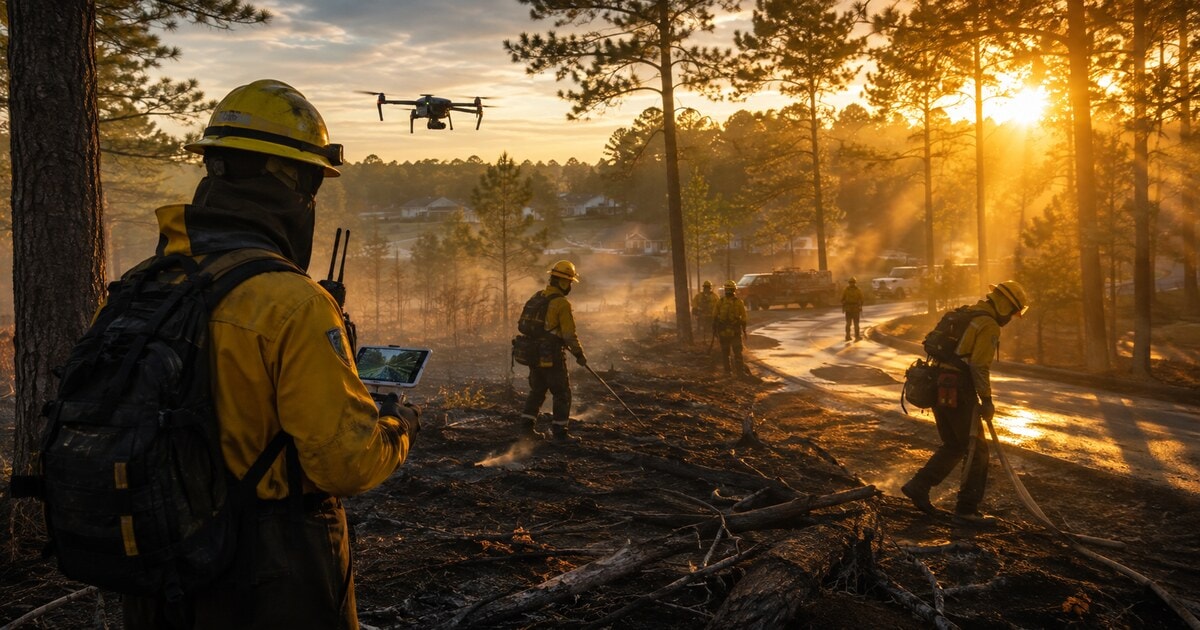
The image accompanying this article is an original symbolic illustration. It honors the kind of coordinated response described in the public record but does not portray a real firefighter, a specific home, the actual drone flight or a documentary moment from Peach Tree Road.
The cause remained under investigation in the most recent local report. RepWatchr will not assign blame or imply a cause that officials have not established. McCrady's confirmed point was narrower: whatever started the fire, the dry conditions made its behavior more extreme.
The responders' work also carries a practical message for the rest of East Texas. Texas A&M Forest Service says equipment use and careless debris burning account for half of Texas wildfires. Its prevention guidance warns that dragging trailer chains, wheel rims striking pavement, malfunctioning catalytic converters, hot machinery and mowing in dry conditions can all produce an ignition.
A burn ban is necessary in dangerous conditions, but it cannot stop every spark. People still drive, tow trailers and operate equipment. That is why equipment inspection is part of community fire protection: inflate tires, secure chains, maintain bearings and exhaust systems, avoid parking on dry grass and carry a way to report a fire immediately.
McCrady urged residents to call 911 as soon as they see smoke or flame. Early reporting gives local departments a chance to stop a small fire before it becomes a long campaign. In a volunteer fire district, it also reduces the time neighbors must leave jobs and families to protect the rest of the community.
Payne Springs Fire Rescue's response is part of a wider East Texas system. Local volunteer departments provide the first attack in many rural areas. County officials manage roads and warnings. Utilities address damaged infrastructure. Texas A&M Forest Service supplies wildland expertise, specialized equipment, aviation or incident support when conditions demand it. No single agency can safely do every part alone.
The 54-acre loss is significant for the landowner. Pine timber represents years of growth and future income, and severe crown fire can kill trees that might otherwise survive a surface burn. Recognition of the crews should not erase that damage. It should acknowledge that containment prevented an already costly incident from continuing to grow.
There is also a long-term lesson in the wildland-urban interface, where homes and roads meet forests and fields. Texas A&M Forest Service describes community wildfire-protection planning as a collaboration among local government, emergency responders and residents. Plans can identify high-risk areas, fuel-reduction projects, equipment needs, training gaps and ways to reduce the chance that a structure ignites.
Henderson County residents can ask whether their community has a current wildfire plan, whether volunteer departments have enough brush trucks and protective gear, and whether mutual-aid agreements are exercised before a large fire. Those are not criticisms of responders. They are ways to give responders the support their work requires.
Volunteer departments also need sustainable staffing. A fire that begins on a weekday afternoon still requires trained people to answer. Counties and emergency-service districts can publish volunteer numbers, response times, equipment replacement schedules and training needs, then tell residents exactly how to help without interfering at a scene.
The Payne Springs response combined quick suppression with patient cleanup. Firefighters controlled a rapidly moving incident. State personnel then used technology to find threats the eye might miss. Road and utility crews managed the damaged pole and closed area. That sequence is disciplined public service.
Hero stories are strongest when they name the work rather than inventing drama. Here, the verified work was difficult enough: confront unusual crown fire in dry timber, contain 54 acres, protect the public from a damaged power line and return to hunt for heat before it could flare again.
East Texans can honor that effort by doing the quiet prevention work at home and on the road. Secure the trailer chain. Check the tire. Avoid hot equipment in dry grass. Follow local restrictions. Call early. The crews near Payne Springs did their part after ignition. The rest of the region can help prevent the next one.
Related RepWatchr records
Source Packet
Source review recorded August 18, 2026 by RepWatchr source desk.
Public Discussion
0 commentsSources linked
Share the receipt, not just the outrage.
Source-backed snippet
RepWatchr story: Payne Springs Crews Contained a 54-Acre Wildfire—Then Returned With a Thermal Drone. Read the linked sources and review status before sharing. https://www.repwatchr.com/news/payne-springs-wildfire-crews-54-acres-2026
Before the meeting
Before the meeting: open Payne Springs Crews Contained a 54-Acre Wildfire—Then Returned With a Thermal Drone, name the public source, ask what record answers the question, and request the missing link be posted for voters.
Ask this public question
Can you point voters to the public record, vote, filing, agenda, or source link that supports your position on Payne Springs Crews Contained a 54-Acre Wildfire—Then Returned With a Thermal Drone? Current source trail: KETK.
Your next useful move
Pick one action that adds a record, checks a claim, or shares the receipt.
Source file
This page is for the story, the receipt, and the next record to check.
Story
Payne Springs Crews Contained a 54-Acre Wildfire—Then Returned With a Thermal Drone
Receipt
Source: KETK
Follow-up
Review linked profiles, source links, or missing public records.
Social snippet
RepWatchr story: Payne Springs Crews Contained a 54-Acre Wildfire—Then Returned With a Thermal Drone Why it matters: Payne Springs Fire Rescue and Texas A&M Forest Service crews contained a fast-moving 54-acre wildfire in Henderson County, then used a thermal drone to search for hidden hot spots. Their response protected the community while underscoring the danger of dry East Texas fuels. Receipt: Source: KETK Source file: https://www.repwatchr.com/news/payne-springs-wildfire-crews-54-acres-2026