
The D.C. Guard Mission Now Runs to 2029. The Pentagon Estimates Another $1.4 Billion
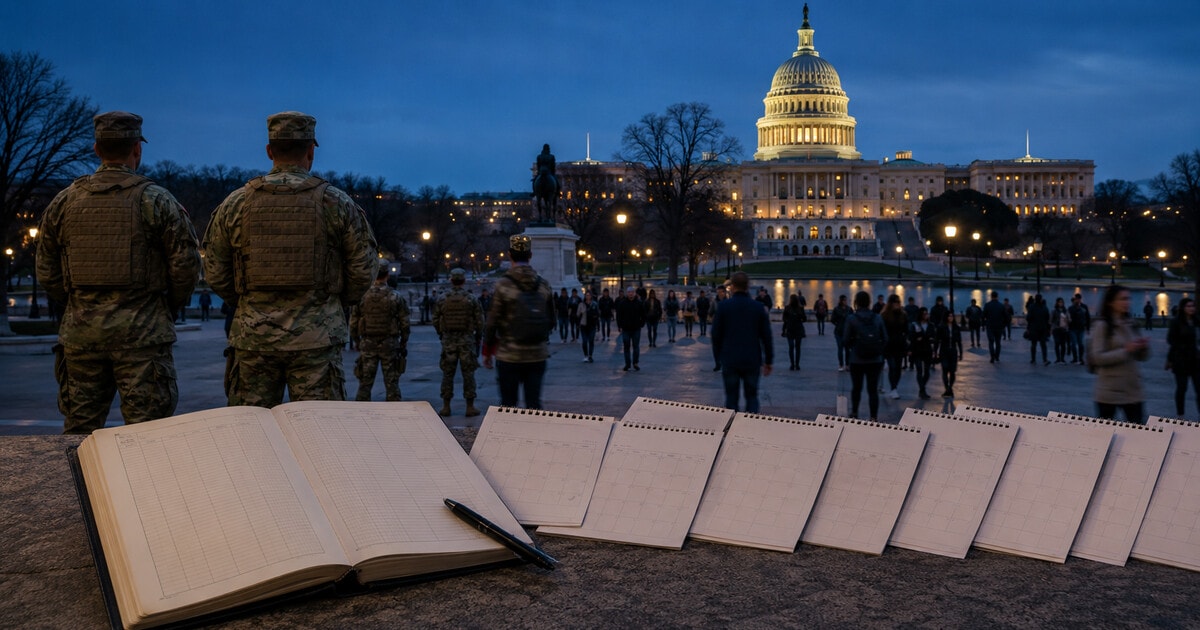
D.C. Guard Through 2029: The $1.4B Estimate
A year after President Trump began the D.C. Guard mission, the Pentagon says it can continue through Jan. 20, 2029. A Defense Department estimate puts fiscal 2027–2029 costs near $1.4 billion.
One year after President Donald Trump launched a federal law-enforcement surge and National Guard mission in Washington, D.C., the deployment has changed from an emergency response into a plan that can last through the end of his term. The Pentagon says the mission may continue until Jan. 20, 2029, or until the president ends it earlier. A Defense Department estimate provided to Congress puts the cost for fiscal years 2027 through 2029 at roughly $1.4 billion.
Those two facts—the duration and the price—make the deployment a national accountability issue, not only a dispute inside the capital. The estimated cost assumes an average of 2,500 Guard members in Washington through January 2029, according to the Associated Press. The current force has been larger: AP reported about 4,600 personnel from the District and 23 states around the first anniversary, after the number rose to about 5,000 during the nation’s 250th-anniversary celebrations.
The mission began Aug. 11, 2025, when Trump declared a crime emergency in Washington, temporarily directed the city’s police department to provide services for federal purposes and activated the D.C. National Guard. The Defense Department initially mobilized about 800 Guard members. Its stated duties included support for federal and local law enforcement, monument and facility security, community patrols, traffic control and beautification.
The administration credits the broader task force with arrests, weapons seizures and falling crime. Guard members have also responded to medical emergencies, removed trash, assisted with snow operations and supported law-enforcement activity. The Guard generally does not make arrests; federal or local law-enforcement officers take the lead when an enforcement action is required.
Critics, including D.C. officials and congressional Democrats, argue that keeping armed military personnel on city streets after the original emergency period threatens local self-government, normalizes domestic military deployments and spends defense money on a mission whose public-safety benefit has not been isolated from other factors. Those are serious objections, but they are arguments and legal claims—not final findings that every part of the mission is unlawful or useless.
The crime debate requires careful timing. Violent crime in Washington declined before the August 2025 deployment and continued declining afterward. The AP’s anniversary review reported a 32% decline in homicides during the relevant comparison period, while noting disagreement about what caused it. The administration says the visible federal presence and joint operations accelerated safety gains. Local officials and independent analysts point to earlier trends, policing changes and other community factors. A simple before-and-after comparison cannot by itself assign causation.
The underlying data have also faced scrutiny. Allegations that a police official manipulated crime classifications led to investigation and fueled doubts among supporters of the federal intervention. That controversy does not prove all city statistics are false, just as a decline in reported crime does not prove the Guard caused it. Congress and the public need offense-level data, reporting-method explanations and independent evaluation.
The cost estimate is clearer but still needs context. Roughly $1.4 billion covers the projected fiscal 2027–2029 continuation, not necessarily every dollar spent since the mission began. The figure includes assumptions about average staffing and operating costs that can change. It should not be described as a completed expenditure today. The Pentagon should publish the estimate, its staffing assumptions and the appropriations accounts being used so taxpayers can compare planned and actual costs.
Sen. Elizabeth Warren, a Massachusetts Democrat who requested cost information, called the deployment a political use of troops and taxpayer money. The administration disputes that framing and describes the Guard as a force multiplier supporting safety and public service. RepWatchr attributes those positions because neither side’s characterization is a neutral fact. The inspectable facts are the orders, head count, mission tasks, expenditures, crime data, court filings and documented outcomes.
The legal structure is unusual because Washington is not a state. The president has direct authority over the D.C. National Guard that governors exercise over their state forces. The District’s Home Rule Act also gives the federal government powers that do not exist in the same form over a city such as Houston, Chicago or Los Angeles. That distinction is one reason the Washington mission has continued while courts constrained or paused deployments elsewhere.
D.C. Attorney General Brian Schwalb sued in September 2025 to end the deployment, arguing that military support for local law enforcement exceeded lawful authority and harmed the District’s autonomy. The federal government defends the mission as authorized and supportive rather than a replacement for civilian policing. Litigation has produced rulings and appeals, and readers should distinguish temporary orders from a final judgment. A pending case does not resolve the nationwide constitutional question by itself.
The human record is more complicated than either political narrative. Guard members have provided medical aid and other public services. They have also spent long periods away from families, civilian jobs and ordinary training. In November 2025, West Virginia Guard member Spc. Sarah Beckstrom was killed and Staff Sgt. Andrew Wolfe was wounded in an attack near the White House while deployed. Any debate about cost or authority should recognize that service members bear the policy’s personal risk.
Congress has several duties even if it does not control every operational decision. Lawmakers appropriate defense money, oversee readiness and can demand reports. They should ask which units are serving, how long individual tours last, what training is deferred, how states are reimbursed, whether troops receive full benefits, what rules govern weapons and use of force, and which civilian agency requests each task.
Congress should also require outcome reporting that matches the claimed purpose. If the mission is justified as a crime deterrent, officials should publish the categories of incidents Guard members directly assisted, response times, arrests completed by partner agencies, weapons recovered through operations involving Guard support and geographic deployment patterns. If the mission includes beautification, medical aid and snow response, those outputs should be reported separately rather than rolled into a single public-safety claim.
The administration owes the same precision. A cumulative arrest figure for a multi-agency task force does not show how many arrests were attributable to Guard assistance, how many involved serious violent offenses, how many resulted in charges or how many cases were dismissed. Listing those outcomes would let supporters demonstrate value and critics test it. Public safety is too important for inflated totals.
District officials likewise should publish comparable, audit-ready crime data and correct errors openly. Their strongest argument for home rule is competent, transparent local government. If classifications changed, the city should say when and why. If a federal operation disrupted local priorities, officials should document the impact rather than rely only on constitutional rhetoric.
The 2029 end date also raises an election-year question. The mission is scheduled to cover the 2026 midterms and continue through the 2028 presidential election and inauguration period unless ended earlier. That does not prove troops will be used for partisan purposes. It does make written mission boundaries, civilian control and nonpartisan rules especially important. Military personnel should never be placed in a position where ordinary election administration or peaceful political activity can be mistaken for a security threat.
A durable policy cannot depend on whether a voter trusts this president. The precedent will be available to future presidents of either party. Republicans who support the deployment should ask what limits they would want under a Democratic administration. Democrats who oppose it should state what emergency conditions would justify federal military support in the capital. A rule that survives party reversal is more reliable than one built around a single officeholder.
The immediate public-record checklist is short. Release the Defense Department’s full cost response. Publish current troop counts and contributing states. Separate security, law-enforcement support and civic-service tasks. Report injuries, use-of-force incidents and complaints. Show monthly spending by account. Provide crime data with consistent definitions. Update the status of the District’s lawsuit and any appeal.
The country can recognize Guard members’ service while questioning the policy that placed them there. It can acknowledge lower crime while asking what caused it. It can value a safe capital while defending local democracy and civilian policing. Those positions are not mutually exclusive.
What has changed by this anniversary is the burden of proof. An emergency deployment measured in weeks can rely on immediate necessity. A mission planned through Jan. 20, 2029, at an estimated additional cost of $1.4 billion must show goals, legal authority, measurable results, readiness effects and a credible exit standard. The Pentagon’s estimate gives Congress and taxpayers a number. Now they need the receipts behind it.
Related RepWatchr records
Source Packet
Source review recorded August 10, 2026 by RepWatchr source desk.
Sources linked
Share the receipt, not just the outrage.
Source-backed snippet
RepWatchr story: The D.C. Guard Mission Now Runs to 2029. The Pentagon Estimates Another $1.4 Billion. Read the linked sources and review status before sharing. https://www.repwatchr.com/news/dc-national-guard-deployment-2029-cost-2026
Before the meeting
Before the meeting: open The D.C. Guard Mission Now Runs to 2029. The Pentagon Estimates Another $1.4 Billion, name the public source, ask what record answers the question, and request the missing link be posted for voters.
Ask this public question
Can you point voters to the public record, vote, filing, agenda, or source link that supports your position on The D.C. Guard Mission Now Runs to 2029. The Pentagon Estimates Another $1.4 Billion? Current source trail: Associated Press.
Your next useful move
Pick one action that adds a record, checks a claim, or shares the receipt.
Source file
This page is for the story, the receipt, and the next record to check.
Story
The D.C. Guard Mission Now Runs to 2029. The Pentagon Estimates Another $1.4 Billion
Receipt
Source: Associated Press
Follow-up
Review linked profiles, source links, or missing public records.
Social snippet
RepWatchr story: The D.C. Guard Mission Now Runs to 2029. The Pentagon Estimates Another $1.4 Billion Why it matters: A year after President Trump began the D.C. Guard mission, the Pentagon says it can continue through Jan. 20, 2029. A Defense Department estimate puts fiscal 2027–2029 costs near $1.4 billion. Receipt: Source: Associated Press Source file: https://www.repwatchr.com/news/dc-national-guard-deployment-2029-cost-2026